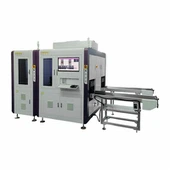
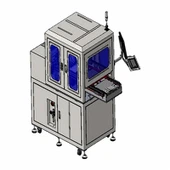
In modern manufacturing, precision measurement and quality control are becoming increasingly important. With ever-increasing production demands, many companies are relying on efficient and accurate measurement tools to ensure the quality and precision of every part. Gantry-type automatic optical image measuring instruments, with their advantages of non-contact measurement, high precision, and automation, have become the preferred choice for many manufacturers and engineers. So, how do you choose the right gantry-type automatic optical image measuring instrument for your company from among the many available products? In this article, I will provide you with a detailed buying guide, explaining why you should choose a gantry-type automatic optical image measuring instrument instead of a bridge-type image measuring instrument when dealing with large workpieces.
A bridge-type vision measuring instrument is a relatively common precision measuring device. Structurally, it resembles a bridge, with the measuring platform located beneath the bridge, and the sensor moving above the platform via the bridge structure to perform measurements. Bridge-type devices are typically suitable for measuring smaller workpieces, and they offer excellent performance, especially when high precision is required. However, bridge-type devices do have certain limitations.
In contrast, gantry-type vision measuring instruments have distinct advantages in measuring large workpieces. The design of gantry-type equipment features the measuring sensor suspended from a gantry frame, while the workpiece is placed on a stable worktable. This structure allows gantry-type vision measuring instruments to better handle the measurement tasks of large and heavy workpieces.
Part Two: The Three Key Factors for Gantry-Type Machines to Conquer Large Workpieces
Lorem ipsum dolor sit amet consectetur adipisicing elit.
1. Stability and accuracy
The static figures on the accuracy parameter table look impressive, but the real test lies in dynamic measurements. During large-travel movements, the cantilevered beam of the bridge structure acts like a lever, and the inertia from high-speed starts and stops leads to subtle, difficult-to-eliminate twisting and vibration. In testing, when measuring two points at the far end of the same workpiece, the bridge-type device showed excessive fluctuations over ten repeated measurements.
What about the gantry-type system? Its core moving part is the platform, which has a uniform mass distribution and smooth drive. The robust, fixed bridge provides a true base for all optical components. This means that its stability remains consistent regardless of the starting or ending point of the measurement travel. For me, long-term, repeatable accuracy is far more valuable than the highest accuracy stated on paper.
2. Load Capacity and Space: Truly Large Travel Range
This is the most obvious advantage. With bridge-type equipment, the space beneath the bridge is fixed. If your workpiece is too tall, or requires complex rotating fixtures or hydraulic positioning devices, the risk of interference increases dramatically.
The gantry-type system provides an extremely spacious measurement area without any overhead obstructions. This freedom of space not only makes measurement more convenient but also paves the way for future integration of automation and the creation of measurement cells. It's not just an investment for the present, but also an investment in the potential to meet complex future demands.
3. Long-term durability: An underestimated hidden cost
Equipment is a durable good, but maintenance costs and lifespan directly affect return on investment. The core guide rails of bridge-type structures, after long-term exposure to uneven cantilever loads, experience faster and more uneven wear, directly impacting the long-term maintenance of accuracy.
Gantry-type structures, due to their symmetrical and balanced force distribution, have a more scientifically designed stress distribution in their mechanical structure, resulting in more uniform and consistent wear on the guide rails. Under the same usage intensity, gantry-type equipment exhibits a significantly longer period before accuracy degradation, meaning lower long-term maintenance costs and a longer investment lifespan. In the field of precision manufacturing, stability and reliability are the greatest cost savings.

Part Three: Objectively speaking, the value proposition of bridge-type imaging systems
This is by no means a rejection of bridge-type vision measuring systems. In applications involving small travel ranges, lightweight workpieces, and where optimal cost-effectiveness is desired, such as the inspection of small precision electronic components, tools, and plastic parts, the bridge structure remains the absolute mainstream due to its compactness, efficiency, and cost advantages. It can play a significant role in flexible applications within small travel ranges.
Choosing the right gantry-type automatic optical image measuring instrument is a comprehensive decision involving multiple factors such as measurement accuracy, production needs, budget, brand, and after-sales service. Before purchasing, it is crucial to assess your specific needs and thoroughly understand the technical parameters of the equipment. Most importantly, choose a trustworthy supplier and brand to ensure the equipment can meet your company's long-term development needs.

Manufacturers interested in gantry-type fully automatic optical image measuring instruments.
Selecting an equipment supplier with mature technology, a high℃of automation, digital management capabilities, and comprehensive after-sales service is key to enhancing core competitiveness and meeting future market challenges. If you are interested in our equipment or need a more efficient solution, please contact us and we will provide you with the most dedicated service.